
NXP 74HC157D: A Comprehensive Guide to the Quad 2-Input Multiplexer
In the world of digital logic design, efficiently routing and selecting data is a fundamental task. The NXP 74HC157D stands as a classic and highly reliable solution for this purpose. This integrated circuit is a member of the widely used 74HC high-speed CMOS family, renowned for its low power consumption and robust performance. As a quad 2-input multiplexer, it packs four independent multiplexers into a single 16-pin package, making it an indispensable component for data selection, routing, and parallel-to-serial conversion applications.
Understanding the Multiplexer Function
At its core, a multiplexer (MUX) acts as a digitally-controlled selector switch. For each of its four channels, the 74HC157D has two data inputs (1A, 1B; 2A, 2B; etc.), one output (1Y, 2Y; etc.), and a common select input (S). A single active-low output enable pin (E̅) controls all four outputs simultaneously. The logic is straightforward:
The select input (S) chooses which of the two input sources (A or B) is connected to the output Y.
When `S = LOW`, the Y output presents the data from the A input.
When `S = HIGH`, the Y output presents the data from the B input.
When the output enable (E̅) is held HIGH, all outputs are forced into a high-impedance state (effectively disconnected), regardless of the other input conditions. This is crucial for bus-oriented systems where multiple devices share the same data lines.
Key Features of the 74HC157D
The 74HC157D offers a compelling set of characteristics that have ensured its longevity in the electronics industry:
Quad Configuration: Contains four identical 2-input multiplexers, saving board space and reducing component count.
High-Speed CMOS Technology: Provides low power dissipation typical of CMOS chips while offering speed comparable to LSTTL logic.
Wide Operating Voltage Range: Can operate from 2.0 V to 6.0 V, making it compatible with various system voltages, including modern 3.3V and legacy 5V systems.
Low Power Consumption: Very low static and dynamic power consumption, ideal for battery-powered devices.
Balanced Propagation Delays: Ensures synchronous operation across all channels.
Output Capability: Standard output current allows it to drive up to ten LSTTL loads.
Pinout and Functional Diagram
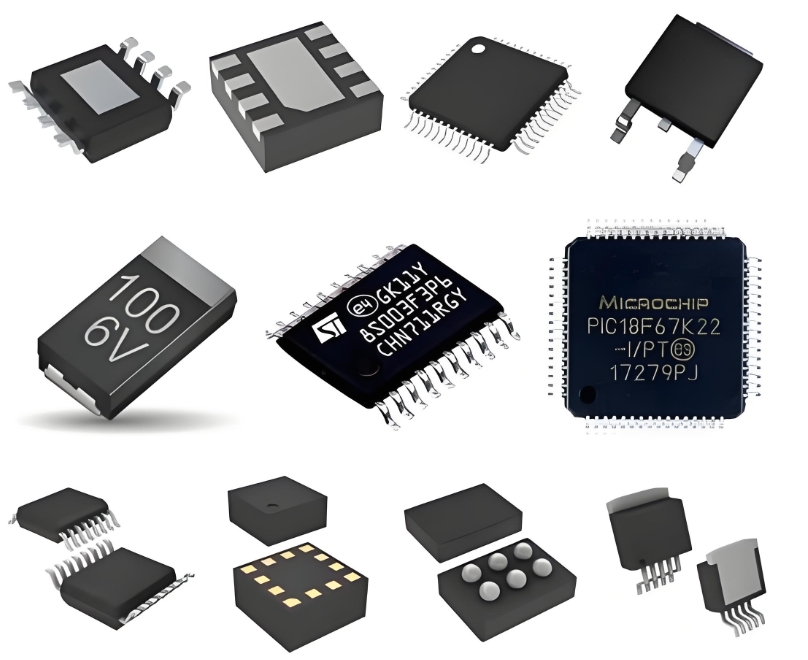
The 74HC157D is housed in a standard SOIC-16 package. Its pin configuration is logically arranged:
Pins 1, 4, 10, 13: Select Input (S) - Common to all four multiplexers.
Pins 2, 5, 11, 14: Data Inputs (A) - Inputs 1A, 2A, 3A, 4A.
Pins 3, 6, 9, 12: Data Inputs (B) - Inputs 1B, 2B, 3B, 4B.
Pins 7, 8, 15, 16: Outputs (Y) - Outputs 1Y, 2Y, 3Y, 4Y.
Pin 8: Ground (GND)
Pin 16: Supply Voltage (VCC)
The common Select (S) and Output Enable (E̅) pins significantly simplify the control logic for all four units.
Practical Applications
The versatility of the 74HC157D makes it suitable for a wide array of applications:
Data Routing and Selection: Choosing between two different data sets from peripherals, sensors, or memory banks.
Parallel-to-Serial Conversion: By sequentially toggling the select line (S), the four parallel data bits presented at the A and B inputs can be read out serially.
Function Generation: Implementing Boolean functions by wiring inputs to logic levels and using the select line as an input variable.
Bus System Management: Allowing multiple data sources to share a common bus line without conflict, with the Output Enable pin used to isolate the chip when not active.
Design Considerations
When integrating the 74HC157D into a circuit, designers should consider:
Decoupling: A 0.1µF ceramic decoupling capacitor should be placed as close as possible between the VCC and GND pins to suppress high-frequency noise.
Unused Inputs: Any unused data inputs must be tied to either VCC or GND to prevent floating input states, which can lead to increased power consumption and unpredictable behavior.
Fan-out: While capable of driving many inputs, ensure the total capacitive load does not exceed specifications for the desired operating speed.
HC Compatibility: Its outputs are compatible with CMOS, NMOS, and TTL inputs, providing great interoperability.
ICGOODFIND: The NXP 74HC157D remains a cornerstone of digital logic design. Its efficient integration of four multiplexers, combined with the robust performance of the HC family, offers designers a simple, reliable, and cost-effective solution for data selection tasks. Its wide voltage range and low power consumption ensure its relevance in both modern and legacy designs, from simple hobbyist projects to complex industrial systems.
Keywords:
1. Multiplexer (MUX)
2. Data Selection
3. CMOS Logic
4. Quad 2-Input
5. Output Enable

